
8 April 2026
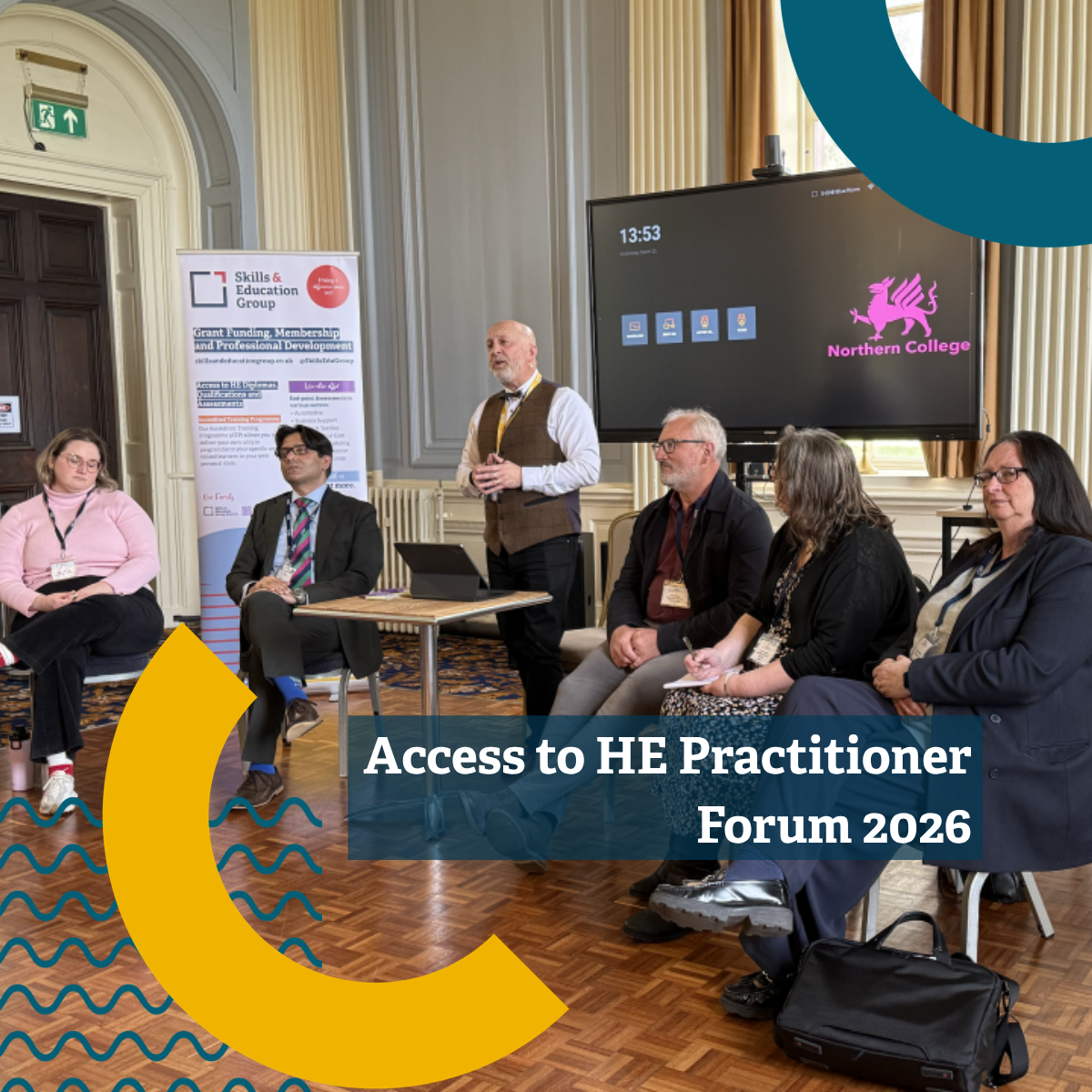
One of the standout sessions at the Access to HE Practitioner Forum 2026 was the HE Question Time Panel, which brought together higher education colleagues to explore what makes Access to HE students distinctive, the challenges they can face in transition, and how practitioners can best support successful progression.
The discussion offered a thoughtful and encouraging perspective on the value Access to HE students bring to higher education, while also addressing some of the practical, academic and emotional challenges that can shape their university experience.
What makes Access to HE students stand out?
A clear theme emerged from the panel: Access to HE students bring commitment, maturity and purpose.
Chiara Amoretti highlighted the depth of engagement many Access students demonstrate when they enter higher education. For many mature students, university is not a default next step but a major life decision and a significant personal investment. As a result, they often arrive highly motivated, ready to participate and determined to make the most of the opportunity.
Dr Phil Bloor reflected on the strong academic preparation Access students often bring, particularly in research, writing and independent study. In many cases, he suggested, they can adjust to higher education study more readily than students arriving through traditional routes, because the shift in expectations and ways of working is often less abrupt.
Dr Amanda Harrison emphasised the determination and ambition that Access students bring. Unlike some younger applicants who may still be deciding what comes next, Access students have often already made a deliberate and considered choice to return to education and progress into higher education. That sense of purpose can be evident from the beginning.
Claire Swales added that Access students often enrich the wider student community. Their life experience, maturity and inclusivity can have a positive effect on the whole cohort, helping to strengthen peer learning and raise confidence more widely.
Professor Fawad Inam echoed these strengths and highlighted the value of deliberately bringing together mature learners and more traditional entrants. From his perspective, that mix can create powerful peer-to-peer learning, where students benefit not only from subject teaching but also from each other’s different experiences and perspectives.
The challenge is often transition, not ability
While the panel strongly affirmed the academic strengths of Access students, there was also recognition that transition into higher education can still be difficult.
A recurring theme was belonging. Several panellists spoke about the fact that mature students can feel out of place when moving from a smaller, supportive Access environment into a much larger university setting. Being one of the only mature students in a tutorial group, or joining a large lecture cohort dominated by younger peers, can affect confidence and create a sense of not fully fitting in.
Chiara Amoretti noted that, academically, many Access students find the first year of university manageable and sometimes less demanding than their Access course. The greater challenge is often not academic ability, but circumstance. Many students are balancing study with work, family responsibilities and other complexities, which can make full participation in university life harder.
Dr Amanda Harrison reinforced the importance of belonging, particularly for mature students who may feel very aware of the age gap between themselves and their peers. The issue is often not whether they can succeed academically, but whether they feel that university is a place where they belong.
Professor Fawad Inam brought in a further dimension, particularly in relation to STEM progression. He noted that some students can face challenges with numeracy and mathematical application, especially where subjects demand confidence in areas such as calculus and problem-solving. His view was that teaching in these areas needs to make those skills feel relevant and applied, helping students connect theory to real engineering and scientific contexts.
The importance of relationships with higher education
Another strong message from the panel was the importance of relationships between Access providers and HE institutions.
Dr Amanda Harrison spoke about the value of finding a contact within an institution who understands and supports Access to HE. Even one productive connection, she suggested, can make a significant difference in improving understanding of the qualification and in helping students navigate progression more effectively.
This was echoed by John Earland, who reflected on the benefits of maintaining close relationships with local HEIs. Regular dialogue helped create smoother progression routes, offered useful insight into assessment and expectations, and ensured that Access provision remained aligned with what students would encounter next.
Dr Phil Bloor reinforced this point from an admissions perspective, noting that Access to HE is a strong and well-standardised qualification. The challenge is often less about willingness and more about communication within large institutions. The message was clear: keep talking to universities, keep asking questions and keep building those relationships.
There was also a practical reminder that students themselves should be encouraged to seek information early, attend open days and speak directly to universities. Entry requirements can sometimes appear fixed on paper, but conversations can open doors.
Assessment, AI and the future of learning
The panel also explored the future of assessment, particularly in the context of generative AI.
Dr Amanda Harrison noted that the role of exams varies significantly by subject, with some disciplines moving away from them while others remain heavily reliant on them because of professional requirements. Professor Fawad Inam added that in areas such as STEM, accreditation and professional standards continue to make examinations an important part of assessment, despite the logistical and operational demands they place on universities.
Claire Swales encouraged a broader view, suggesting that exams are not the only response to AI. Instead, the key question may be whether assessment focuses solely on the final artefact or also values the process, judgement and learning that lead to it.
Dr Phil Bloor observed that AI is already reshaping admissions and education more generally, and that the more useful response is now to educate students about how to use it ethically, transparently and appropriately.
Professor Fawad Inam was clear that AI should be approached as a reality to work with, not ignore. He argued for an ethical partnership with AI, recognising both its growing influence and the need to prepare students for a future in which automation, AI and changing professional expectations will become increasingly significant.
Across the panel, there was broad agreement that AI should not simply be seen as a threat. Instead, the challenge for educators is to help students understand its possibilities, limitations and ethical implications, and to prepare them to use these tools responsibly.
Building confidence, resilience and student voice
The closing section of the discussion focused on resilience and the role practitioners play in building student confidence.
Professor Fawad Inam emphasised the importance of emotional intelligence and resilience in an age increasingly shaped by AI and automation. For him, part of the educator’s role is ensuring that students are not only academically ready, but also future-ready as adaptable, thoughtful and emotionally intelligent individuals.
Dr Phil Bloor reflected on the importance of helping students understand that challenge and uncertainty are normal parts of progression. Students do not need everything to feel easy; they need the confidence to cope with what is new.
John Earland raised the importance of allowing students to make mistakes and learn from them in safe, supportive ways, rather than trying to protect them from difficulty altogether.
Claire Swales offered a practical example of how assignments can be designed to build resilience and commercial awareness, by introducing change part-way through a task and asking students to adapt. She also reminded the audience of the importance of listening closely to students throughout their journey, not simply in terms of “student voice”, but through a more genuine partnership approach.
Key messages for practitioners
As the session closed, panellists offered a number of clear messages for those supporting Access to HE students:
• encourage students to seek progression information early and speak directly to universities
• remind them that they are welcome in higher education and that they belong there
• build confidence and resilience, not just academic readiness
• help students connect knowledge to real-world application, especially in specialist and technical subjects
• talk to students regularly and listen carefully to what they are experiencing
• maintain dialogue with HE institutions, because those relationships can make a real difference
Perhaps the most powerful message came from Dr Amanda Harrison: students need to hear clearly that higher education is a place for them. Access to HE students do not just enter university successfully — they enhance it.
The HE Question Time Panel was a strong reminder that Access to HE students bring much more than academic potential. They bring determination, insight, maturity and a powerful commitment to change. The task for all of us is to ensure that their transition into higher education is not only possible, but supported, understood and valued.
Find out more about our events and training here.